
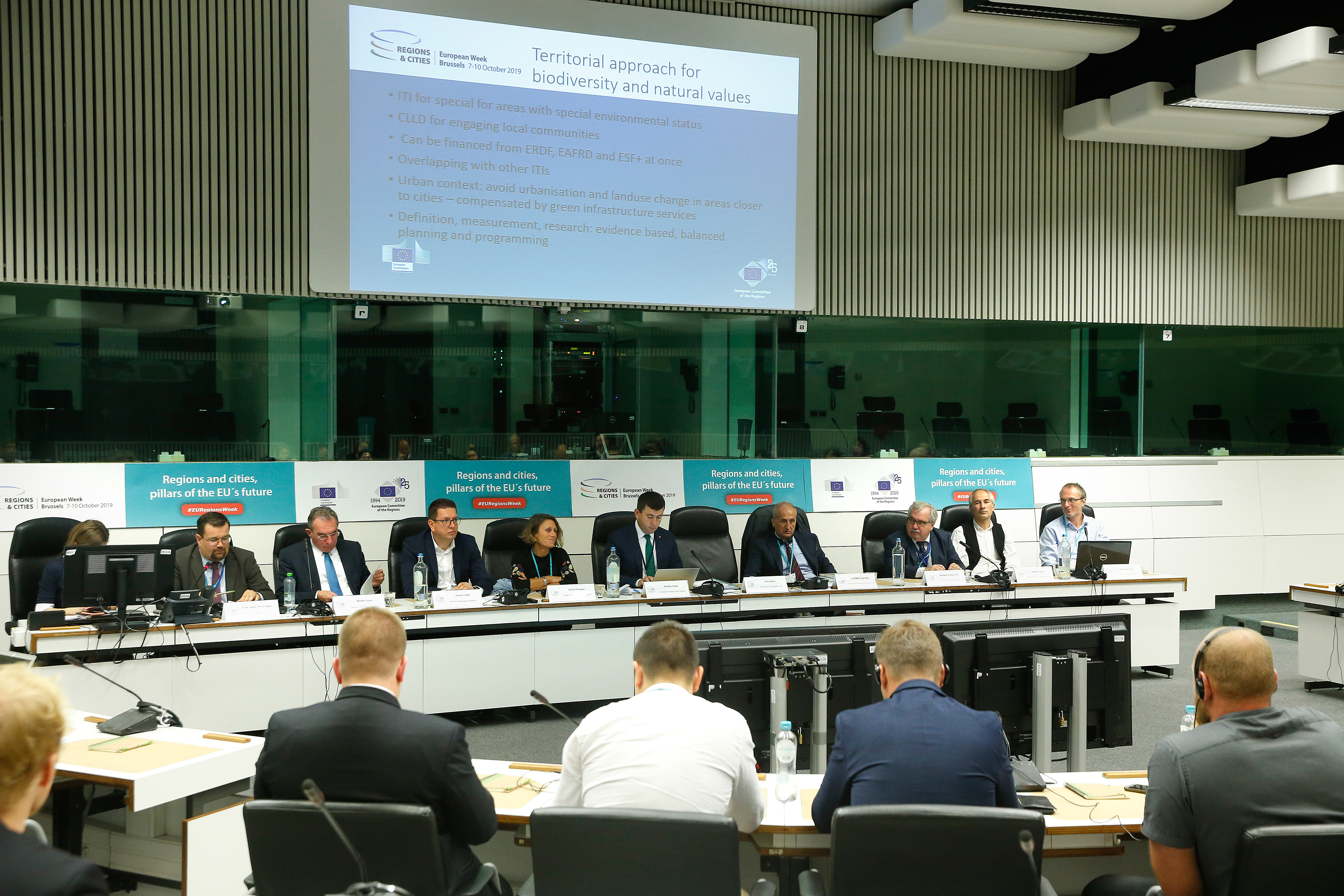
A workshop on biocultural diversity was held in Brussels.
A workshop entitled Biocultural Diversity, as a powerful tool for achieving EU development goals was organized by Harghita County Council in Brussels, within the events’ series of the European Week of Regions and Cities.
As declared by Csaba Borboly, president of Harghita County Council and the host of the event, Seklerland, Harghita county is a region where local communities are still close to nature. „The result of this is cultural and environmental diversity, a value that makes this area very special. We need to implement different developments taking care to preserve this value.” – said the president of the county council. He added that, however traditional knowledge is not yet included in rural development strategies or environment protection directives, the recognition and its definition as a value is becoming more and more important.
„We are working – and organized this workshop for this very reason- so that environmentalists should not consider people as only a tolerated factor, but to recognize people also shape landscapes in a positive way and that harmonious coexistence with nature is possible. One of its evidence is Seklerland, Harghita county! For the preservation of biocultural diversity there is need for resources and financial support – and this is what we are are requesting here in Brussels. – said Csaba Borboly.
Based on his consideration, sustainable development targeting the protection of biocultural diversity can be reached only if we can use the right EU- and national funds on the local level. For example, the LEADER programme can be an optimal framework for the preservation of these values and for this reason more focus needs to be put on the active participation of local administrations, entrepreneurs and civil society.
The event was moderated by Mr. Lóránt Vincze, Member of the European Parliament, also participated Mr. Cor Lamers, president of the ENVE (Commission for the Environment, Climate change and Energy) of the Committee of the Regions, and mayor of Schiedam. During his presentation he also highlighted that the next financial period of the EU needs to focus on the protection of ecosystems and the preservation of biodiversity.
An invited speaker of the workshop was Prof. Mauro Agnoletti, of the University of Florence, leading expert in the field of biocultural diversity. As he declared, Europe is in essence a multifunctional cultural landscapes, people and nature are inseparably linked and this link is a value in itself that constitutes the very heart of European regions and identity. The conservation of complex landscape patterns needs to be ensured through integrated planning and management strategies, particularly in view of the need to adapt to global climate change.
Dr. Tibor Hartel, ecologist, associate professor of the Babeş–Bolyai University and member of the University’s Committee on Biodiversity and Sustainable Development proposed that the elements of biocultural diversity and its heritage should be evaluated on regional level and those areas should be defined that could be financed through pilot projects.
Mr. László Demeter, biologist and head of the Harghita county department of the Romanian National Agency for Protected Areas presented the aspects of biocultural diversity of Eastern Transylvania. Based on his presentation the biocultural diversity can be found all over Europe, it is a manifestation of human-nature coexistence and crucial part of European identity. This is the reason why it should be taken into consideration within political decision making, in education, rural development, environment protection and regional development policies.
The workshop was co-organized by the Institute of Applied Sciences from Italy, represented by dr. Valeria Salvatori. She spoke about the successful cooperation within the European Large Carnivore platform supported by the European Commission and Harghita County Council. She highlighted that for a proper coexistence with large carnivores and for their protection there is a need for a participative approach and support by regional public administrations as well as. .
Mr. András Demeter, senior expert of the DG Environment, Biocultural Unit within the European Commission, presented its position on the debated subject, bringing examples of how current policies incorporate support for cultural diversity. Mr. László Csák, expert on European rural development policies and energy issues presented current frameworks of financial support that could be used for the preservation of biocultural diversity.

Leave a Reply