
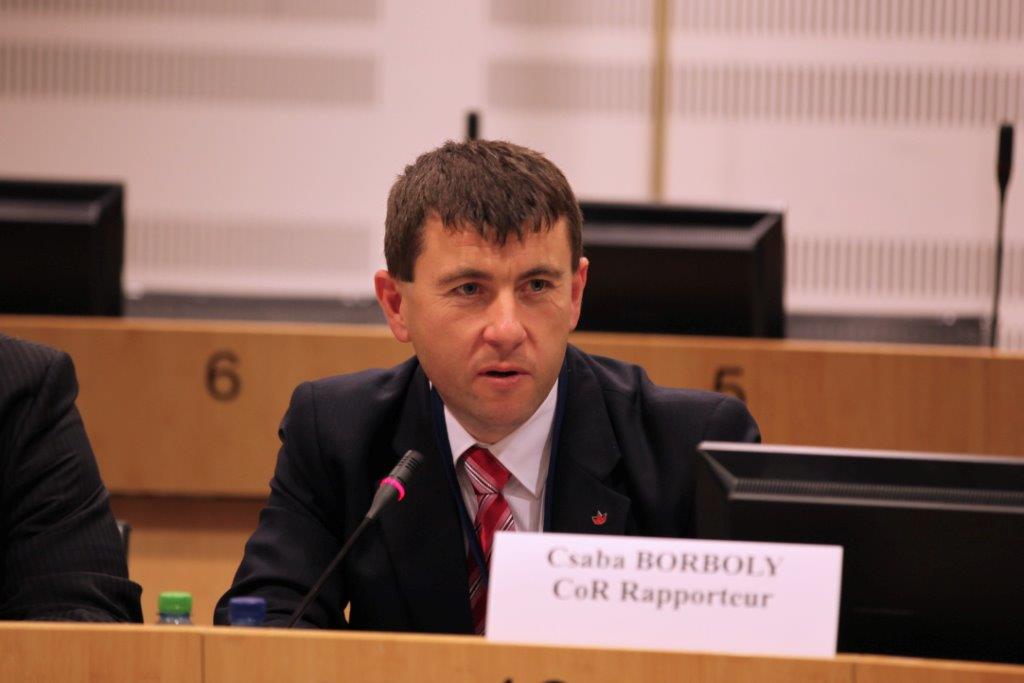
The Commission for Education, Youth and Research (EDUC) of the Committee of the Regions has accepted the draft opinion entitled as ‘European Higher Education in the World’, on 13th of November. Mr. Csaba Borboly, president of Harghita County Council, being the rapporteur of the mentioned document underlined that ‘in a multilingual and multi-ethnic Europe, institutions of higher education offering learning opportunities in minority languages can play a very significant role’. The draft opinion tackles with priority the involvement of higher educational institutions least fulfilling the conditions of internationalisation for the purpose of increasing the competitiveness of European higher education.
According to Mr. Csaba Borboly, the fact that the draft opinion has been accepted is a breakthrough taking into account that his amendments related to ethnic minority groups have been so far rejected several times. Hence, this can be one of the few EU documents, where the issue of minority groups is dealt by. Besides the county council president, the local expert invited by him, Mr. László Csák considers despite the fact that the draft opinion of the Committee of the Regions is not yet an enforced EU legislation but still it is a great result. He outlined that ‘in two subjects we could reach a compromise with the EPP and PES: firstly, that educational institutions offering courses also in minority languages have an essential role; secondly, between the period of 2014 and 2020 the Committee of the Regions recommends that members states, among them Romania also, should support those higher educational investments, which are tendered by smaller, regional universities for strengthening their competitiveness.’
The president of EDUC Commission, Mr. Anton Rombouts congratulated to Mr. Csaba Borboly. Nevertheless, as he mentioned the document has to be accepted by the Committee of the Regions on its plenary meeting organized in January 2014 as well, pointing out that the battle is already won but the war is not yet. However, he concluded that the situation is favourable since the EDUC Commission unanimously adopted the draft opinion, thus, prior to the plenary session at least 32 signatures are needed to submit an amendment. Mr. Jean Francois Istasse, vice-president of EDUC Commission and member of the Party of European Socialists also had a positive opinion on the document and expressed his gratitude for reaching a consensus regarding the amendments. Mr. Dimitrios Kalogeropolous, the rapporteur of the Commission for Citizenship, Governance, Institutional & External Affairs (CIVEX), declared that the submitted draft opinion is of great importance because in order to attract more talented students it tackles an important precondition of European higher education’s internationalisation. Mr. Csaba Borboly further declared that it is essential to assure the distance learning as well for offering the learning opportunities provided by higher education to students who cannot otherwise afford it.
Regarding the modification of the draft opinion, Mr. Jean Francois Istasse submitted 13 amendments with the aim of changing some parts of the original text. Concerning these 13 amendments, Mr. Csaba Borboly proposed newer amendments regarding four of them, since he firmly beliefs that the regional and minority languages have to be mentioned, since these contribute to the regional integration of higher educational institutions. Furthermore, the county council president added the following: in the course of planning the cohesion and structural policies, member states have to take into consideration the framework programmes on higher education as well; the Committee of the Regions’ draft opinion puts great emphasis on the role of local and regional governments fulfilled in the process of internationalisation; it has to be accentuated the importance of the fact that member states should create supporting programmes, which would contribute to the internationalisation of higher education.
The rapporteur has also underlined the bilateral character of mobility since this has to meet the requirements of both exporting and importing regions as well. Otherwise, problems may occur such as migration, demographic and competitiveness related issues. He stated that ‘the rapporteur activity is new for me, taking also into account that I became member of Committee of the Regions one year ago. The preliminary draft of the present document was sent to EDUC Commission on 17th of October. The elaboration of the document was preceded by several consultations with specialists in the concerned field. I have discussed with the representatives of the Romanian higher education system, with specialists of the European Union institutions, of the higher education representative of the European Commission, last but not least with the Attaché for education of the Lithuanian presidency of the EU’. The rapporteur expressed his gratitude toward the representatives of universities in Harghita County, as well as to the colleagues of Harghita County Council who have contributed to the professional foundation of the draft opinion.
The most significant role of the Committee of the Region’s draft opinion is to voice out the opinions and visions of local and regional governments in order to contribute to the elaboration of EU policies and legislation. Hereby, the proposals have to be presented as to be clearly understood by other institutions as well, since it is quite essential that the most important messages of these documents to be acknowledged, the motivation and reasoning of the Committee of the Regions to be easily followed, as well as to modify the original amendment if necessary.
Miercurea Ciuc, 13th of November 2013

Leave a Reply