
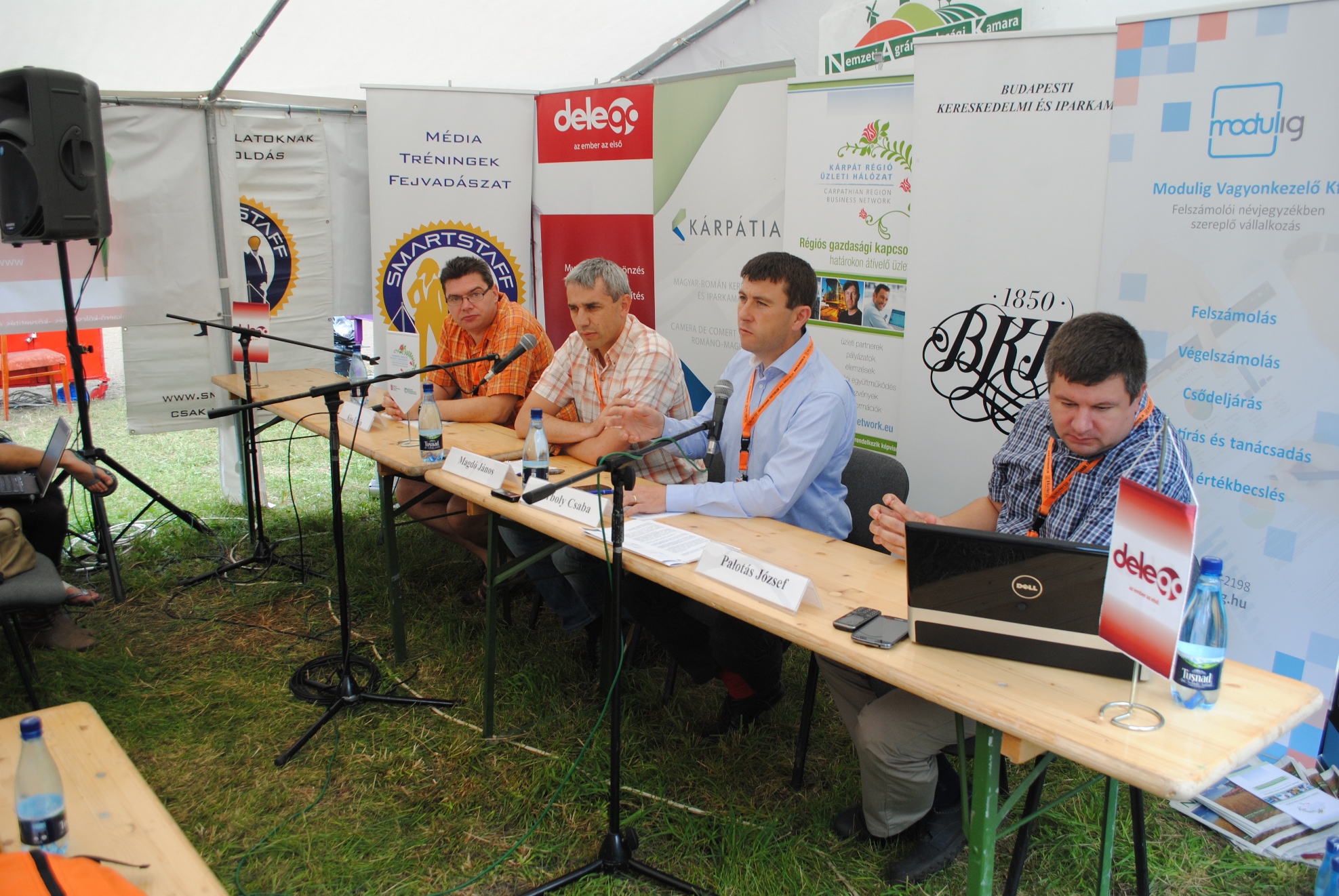
Within the framework of the 25th edition of the “Bálványos” Summer Free University and Student Camp, on 26th of July, it was organized the debate entitled Professional training – The tool of competitiveness. On this occasion, Mr. Csaba Borboly put forward the following: ‘we have to think about strategies fighting migration, since the youth of Seklerland worry about their future and not about losing their ethnical identity.’ On the debate, from Hungary Mr. Ervin Kiss, Secretary General of the Budapest Chamber of Commerce and Industry, Mr. József Palotás, Deputy Director General of the National Labour Office, as well as Mr. János Magdó, Consul General of the Consulate General of Hungary to Cluj-Napoca, were also present.
The county council president explained that the parents and grandparents in Seklerland do not worry about identity-loss, and neither is a reason for doing so. Instead they worry about the fact whether it is worthy or not to expand the apartment/house for their children or grandchildren, because it is not for sure they will stay in their homeland. For this very reason, the most important thematic, politics should deal with it, is to realize the balance between education and market labour demand, and accordingly to create jobs. In Mr. Csaba Borboly’s opinion, the prestige of professional training has to be increased, the parents should see the importance of this, by acknowledging that not merely the theoretical education, final examination is to only way for their children, but great possibilities reside in professional training as well.
The county council president considers that in the Romanian-Hungarian society there is need for re-establishing the confidential connection with entrepreneurs, for which a collaboration covering the whole Carpathian basin would be necessary. The dual citizenship offers favourable circumstances, as well, for example through different scholarships and pedagogue training systems.
“There is need for taking actions and measures since the lack of skilled workman and the high unemployment rate of unskilled workers unfavourably influence the competitiveness of enterprises in the region” – said Mr. Csaba Borboly.
Even if it is not included in the sphere of action of Harghita County Council, this county level public institution supports the establishment of common thinking between professional training schools, entrepreneurs and parents. It participates as an initiator in professional training collaborations beyond the borders, helps to recall to life the professional schools in the Carpathian Basin, the operation of professional clusters which coordinate the collaboration between entrepreneurs.
The county council president told that starting from Autumn of this year, 25 professional training classes will be launched, as well as on the proposal of the Agricultural Chamber of Harghita County (sub-institution of Harghita County Council) a class could be launched even with the participation of children over the age of 16, from Mr. Csaba Böjte, Franciscan monks’ foundation for poor orphans. In this case the practical training would be resolved at farmers of the region, who are open to collaborate.
Local governments have also a role in this issue, since plans can be made for 14 years ahead within professional training.
Mr. Ervin Kiss presented the Hungarian initiation, according to which professional trainings are organized in 18 professional fields. Hungarian students receive a German professional training, and when finishing it they get a certification from the German Chamber, which meets the German requirements. This example could be launched also in Hungarian-Sekler terms, youth in Seklerland receiving such professional training, at the end of which they would be given a certification issued out by the Hungarian Chamber, for example.
Mr. József Palotás reported about the survey targeting the professional training of Hungarian children within the Carpathian Basin, and about how it could be supplemented the lack of skilled worker capacity.
Mr. János Magdó offered a presentation about the initiation aiming the launch of professional trainings in collaboration with the multinational companies and the Reformed College in Cluj Napoca.
Băile Tușnad, 24th of July 2014

Leave a Reply