
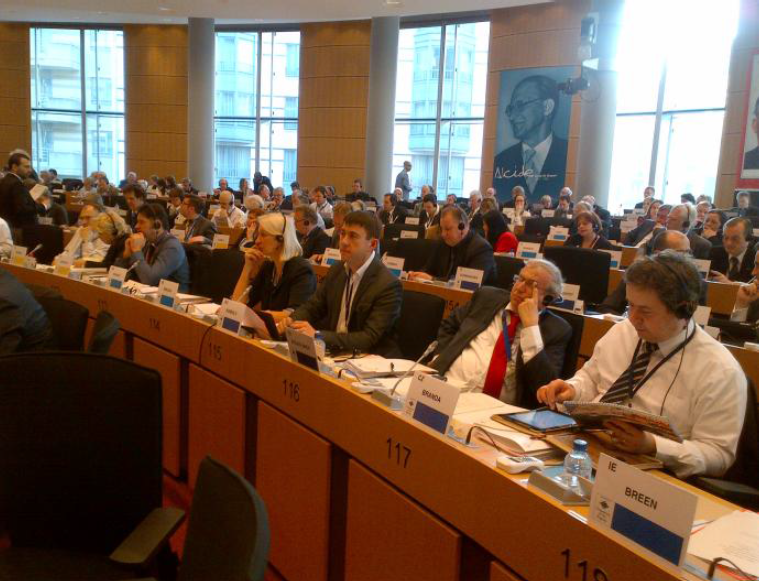
 At the Plenary Session of the Committee of the Regions Mr. Csaba Borboly submitted modifying proposals regarding the greater financial collaborations of the European Union as well as regarding financial supports for using renewable energies. The president of Harghita County Council since October of 2012 is a member in the Committee of the Regions.
On 31st of January and 1st of February 2013 in Brussels one of the most important advisory bodies of the European Union, the Committee of the Regions held a meeting for discussing topics like:’Creating greater synergies between EU, national and subnational budgets’, as well as ’Renewable Energy: A major player in the European energy market’. With regard to these topics Mr. Csaba Borboly, president of Harghita County Council submitted modifying proposals that were accepted by the committee. He raised the attention for the need of a greater financial collaboration within the European Union and for the importance of establishing a European level research network. As the county council president argued that the modifying proposals aim to make more efficient the collaboration between regions, first of all from an economic point of view from the perspective of economy. According to his proposals him the duties and sphere of actions of authorities of different budgetary levels have to be clarified and a clear picture have to be provided on all levels of government regarding the budgetary processes.
The other modifying proposal suggested by Mr. Csaba Borboly refers to price subsidy. Based on this proposal a European level of grant would be created for the support of renewable energy sources. Accordingly, financial support would be allocated for those member states who are endeavouring for energy independency by using alternative and natural energy resources.
Mr. Csaba Borboly stated that ’developing social awareness is an integral part of the new support system’ emphasizing that especially the regions have to play a major role in launching the micro-establishments of the renewable energy sources. He added that using renewable energies may assure the possibility for a self-sustaining economy for all communities and regions. For this very reason it is important to support this proposal respectively to raise the awareness regarding this subject among people. He further noted that ’the most important renewable energy plants of our region are the two water turbines in the settlement of Mădăraș, which establishments prove that in Romania a part of the society is ready for using the new energy.’
Harghita County Council continuously works toward strenghtening the international relations of the region in fields of economy, culture and other areas. In this regard the membership in the Committee of the Regions offers a great possibility and challenge as well in the international activity of the county council. The work of the Committee of the Regions is to validate the local and regional views of opinions related to the legal framework of the European Union, and accordingly it publishes reports and opinions about the proposals of the European Union. Before a desicion is made on European Union level in issues concerning local and regional governments (for example employment policy, environment, education, public health), the Commission, the Council and the Parliament has to consult with the Committee of the Regions first. At the moment there are 344 members and equally the same number of substitute members as well, coming from local and regional authorities from all 27 EU Member States. On local or regional levels the members of the Committee of the Regions are elected members of the local or regional authorities.
The Committee of the Regions organizes 5 meetings yearly, whereto all members are required to participate for the purpose of defining the general strategy respectively concerning the approval of possible proposals too. These plenary sessions are organized for one or for more days. Within the framework of the committee 6 professional commissions are working, which deal with different professional policy fields. Based on these, issues planned to be debated in the plenary sessions are elaborated, as for example: territorial cohesion, economy and social policy, education, youth and research, environment protection, climate change and energy issues, European Union citizenship, governance, external and institutional affairs, as well as use of natural resources.
The Committee of the Regions besides the abovementioned professional policies tackles with important political issues as well. From a political perspective, in the committee 4 political groups are represented according to the main European political directions, namely the European People’s Party (EPP), where Mr. Csaba Borboly is also a member, The Party of European
Miercurea Ciuc, 31st of January 2013

Leave a Reply